Distant Alien Planet: What makes this discovery particularly notable is that the planet was detected through direct imaging, a method that has been used to identify fewer than 2% of the nearly 5,900 known exoplanets
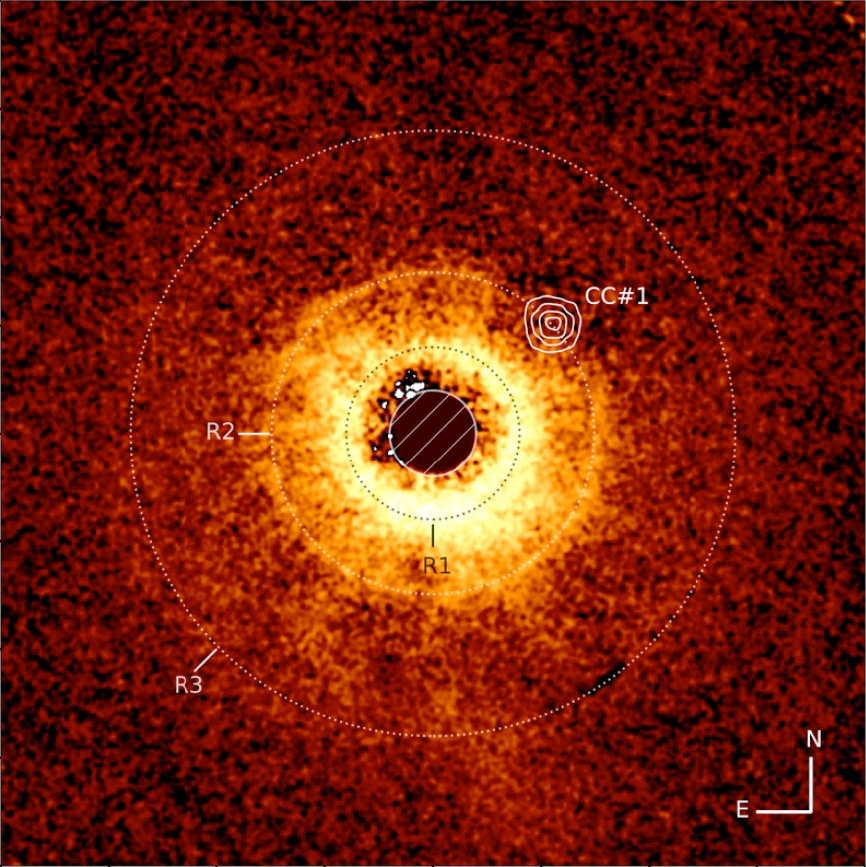
A new composite image showcases the protoplanetary disk surrounding the young star TWA 7, created by combining data from two powerful telescopes. The European Southern Observatory’s Very Large Telescope (VLT) in Chile captured the initial image using its SPHERE instrument, while an overlay from NASA’s James Webb Space Telescope (JWST) was added using its MIRI (Mid-Infrared Instrument).
The image, released on June 25, 2025, highlights a specific region in the disk known as the R2 ring, where the exoplanet TWA 7 b is located. The space around the planet appears as an empty zone, likely indicating the planet’s influence within the dust ring.
This striking visualization provides a clearer look at how young planets like TWA 7 b interact with the surrounding disk material during their early stages of formation. It also demonstrates the value of combining ground-based and space-based telescopic data to better understand distant planetary systems.
(Note: The image is a third-party release and is not available for resale or archival.)
JWST Captures First-Ever Image of a Distant Alien Planet
The James Webb Space Telescope (JWST) has achieved a major milestone by discovering its first previously unknown exoplanet since its 2021 launch. The newly found planet, named TWA 7 b, is a young gas giant about the size of Saturn. It orbits a small star roughly 110 light-years away in the constellation Antlia. This discovery, led by an international team of astronomers and published in the journal Nature, is being hailed as a breakthrough in the study of distant planetary systems.
What makes this finding especially significant is the use of direct imaging, a rarely used method responsible for identifying less than 2% of the nearly 5,900 known exoplanets. Unlike common techniques such as the transit method — which detects planets by the dimming of a star’s light — direct imaging captures actual images of planets. This was made possible by a French-engineered coronagraph on JWST’s Mid-Infrared Instrument (MIRI), which blocks the bright light of the host star to reveal fainter objects nearby.
TWA 7 b orbits its host star at a distance 52 times greater than Earth’s distance from the Sun — farther than Neptune’s orbit. Both the star and its planet are extremely young, only about 6 million years old, compared to our 4.5-billion-year-old solar system.
Thanks to the favorable orientation of the system, scientists also observed the star’s protoplanetary disk, revealing three dusty rings. The planet is embedded within the narrowest of these, offering rare insight into the early stages of planet formation.
This discovery not only demonstrates JWST’s capabilities but also opens exciting new paths for directly observing and studying exoplanets in their formative years.
Important Note:- This information has been taken from tovima.com website