🌌 Introduction
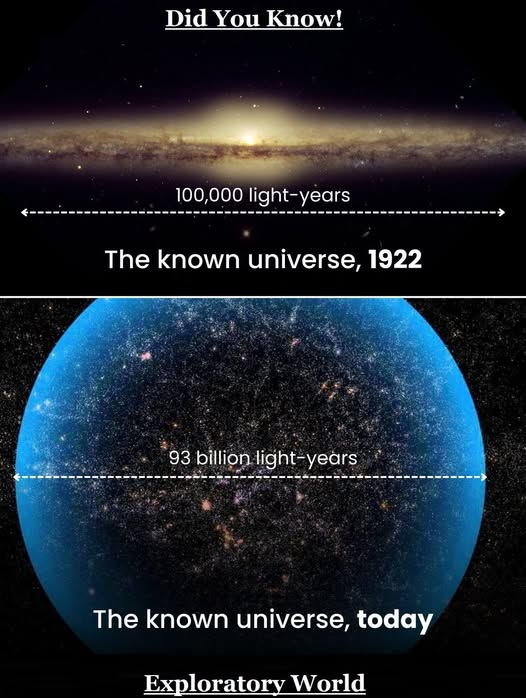
Imagine thinking the entire universe was no bigger than a single galaxy. Just a century ago, in 1922, that was the scientific reality. Back then, astronomers believed everything that existed was confined to the Milky Way, stretching roughly 100,000 light-years across. Mind-blowing, right? Fast forward to today, and we’re staring into a cosmos 93 billion light-years wide—and counting. So, what changed? Let’s dive in.
🔭 The Universe as We Knew It in 1922
The 100,000 Light-Year Misconception
In the early 20th century, even the best minds thought the Milky Way was the universe. Everything we saw through early telescopes—stars, clouds, strange spiral shapes—was assumed to be part of our galaxy.
The Milky Way Was “Everything”
At that point, there was no understanding of separate galaxies. Those fuzzy spots in the sky? They were believed to be “nebulae”—just gas clouds within our own galaxy. It wasn’t ignorance; it was just the limit of technology and evidence.
Limited Telescope Power and Scientific Tools
With no access to space telescopes or powerful detectors, scientists were working with crude tools compared to today’s standards. The night sky was a mystery, and the idea of a vast, expanding cosmos was pure science fiction.
🚀 Enter Edwin Hubble — The Cosmic Disruptor
Who Was Edwin Hubble?
Edwin Hubble, an American astronomer with a keen eye and a sharper mind, would soon revolutionize our understanding of space. Working at the Mount Wilson Observatory in California, he made observations that would shake astronomy to its core.
His Groundbreaking Observations
Hubble focused on a “nebula” called Andromeda. He discovered that it wasn’t inside the Milky Way at all. It was a separate galaxy, millions of light-years away. Boom. The universe just got a whole lot bigger.
The Discovery of Other Galaxies
Once Andromeda was reclassified, the door blew open. More galaxies were spotted, and astronomers quickly realized our Milky Way was just one of billions. The universe as we knew it had shattered—and expanded.
🌠 The Birth of the Expanding Universe
Redshift and the Doppler Effect
Hubble noticed something even more astonishing. Light from distant galaxies was redshifted—meaning they were moving away from us. This wasn’t a fluke; it was happening everywhere.
Galaxies Are Moving Away
This redshift suggested an expanding universe, like raisins moving apart in rising bread dough. The farther the galaxy, the faster it was receding.
Hubble’s Law
He formulated Hubble’s Law, a direct relationship between a galaxy’s distance and its speed. It became one of the cornerstones of modern cosmology.
💥 The Big Bang Theory Emerges
The Universe Had a Beginning
If galaxies are moving apart now, it means they were once closer together. That led to the birth of the Big Bang Theory—the idea that the universe began from a singular point and has been expanding ever since.
Support from Cosmic Background Radiation
The discovery of the cosmic microwave background radiation in the 1960s offered strong support. This faint glow is considered the afterglow of the Big Bang, like the smoke lingering after fireworks.
A New Model for the Cosmos
Suddenly, we weren’t just part of a big galaxy—we were part of a universe that had a beginning, was expanding, and was filled with mysteries yet to be solved.
🗺️ The Modern Cosmic Map
93 Billion Light-Years Wide
Thanks to advancements in technology and math, we now estimate the observable universe to span about 93 billion light-years. That’s not how big it is—that’s just what we can see.
What Does “Observable” Mean?
The universe is about 13.8 billion years old, so you might think we can only see 13.8 billion light-years in any direction. But space itself has expanded, stretching that visible bubble much larger.
Light as a Cosmic Time Machine
When we look at distant galaxies, we’re seeing light that left billions of years ago. So, telescopes are really time machines—giving us a peek into the ancient past.
🌌 Beyond What We Can See
The Concept of the Infinite Universe
Scientists believe the universe extends far beyond the observable limit. How far? Possibly forever. It may go on endlessly, filled with galaxies we’ll never see.
Multiverse Theories
Some theories even suggest we live in a multiverse—a universe among countless others, each with different laws of physics.
Could There Be More Than One Universe?
It’s not science fiction anymore. It’s one of the most fascinating frontiers in modern physics.
🔋 Dark Energy and the Accelerating Expansion
What Is Dark Energy?
In the late 1990s, scientists found that the universe’s expansion is accelerating. The force behind it? A mysterious thing called dark energy, which makes up about 68% of the universe.
How It’s Shaping Our Universe
Dark energy pushes galaxies apart faster over time. It’s one of the biggest puzzles in cosmology today.
🔭 How Technology Changed the Game
Telescopes from Ground to Space
From early ground-based telescopes to the Hubble Space Telescope and now the James Webb Space Telescope, we’ve gone from blurry sky dots to high-definition snapshots of galaxies billions of light-years away.
The Role of Hubble and JWST
Hubble gave us jaw-dropping deep field images, while JWST is peering even farther back in time—almost to the universe’s very first moments.
💡 The Humbling Realization
We’re Tiny in a Vast Universe
From thinking we were the center of everything to realizing we’re a speck in an endless sea of galaxies—that’s a humbling journey.
But We’re Getting Smarter
And yet, with each discovery, we become more enlightened. We’re still figuring it all out—and that’s the beauty of science.
🔚 Conclusion
In just 100 years, we went from believing the Milky Way was the entire universe to mapping a cosmos 93 billion light-years wide—and possibly infinite. The universe didn’t change. We did. We opened our eyes, built better tools, and dared to ask bigger questions. The deeper we look, the more we realize: the cosmos isn’t just vast—it’s full of possibility.
❓FAQs
1. What did scientists believe about the universe in 1922?
They thought the Milky Way was the entire universe, about 100,000 light-years across.
2. How did Edwin Hubble change our understanding of the cosmos?
He proved that other galaxies existed beyond the Milky Way and discovered the universe was expanding.
3. What is the observable universe?
It’s the part of the universe we can see—limited by how far light has traveled since the Big Bang.
4. Is the universe infinite?
We don’t know for sure. The observable part is 93 billion light-years across, but the total universe could be infinite.
5. Why is the universe still expanding?
Because of dark energy, a mysterious force that’s pushing galaxies apart faster over time.
Please don’t forget to leave a review. This article generate with AI.