Mariana Trench: Hidden in the vast blue of the western Pacific, the Mariana Trench is the planet’s ultimate frontier—a colossal scar in the seafloor that reminds us how little of our own world we’ve seen.
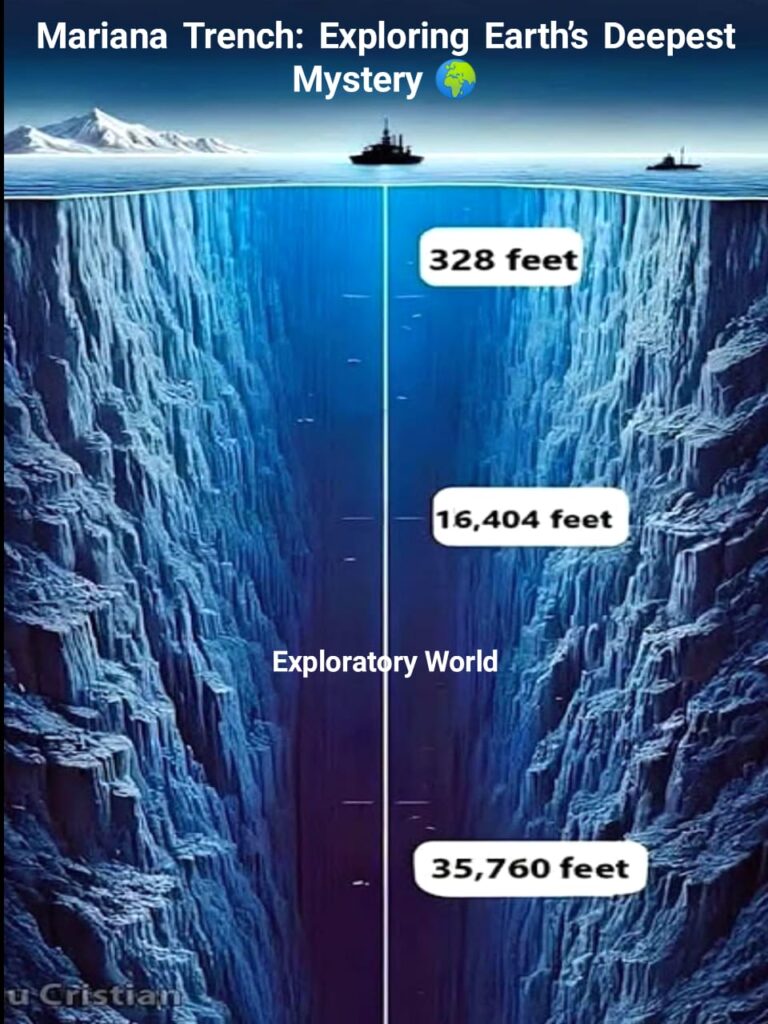
Roughly crescent‑shaped, it arcs for about 2,550 kilometres (1,580 miles) east of the Philippines and curls down to within 200 kilometres (124 miles) of the U.S. territory of Guam.
At first glance those distances seem manageable, yet the trench’s real claim to fame lies in the mind‑bending plunge at its southern end: Challenger Deep.
Mariana Trench: Exploring Earth Deepest Mystery
Mariana Trench: Here, the ocean floor nosedives to an astonishing 10,916 metres—around 35,760 feet—beneath the sea’s surface. If Mount Everest were magically relocated into this abyss, its summit would still sit more than two kilometres below the waves.
Pressures exceed 1,000 times those at sea level, enough to crush unprotected equipment in an instant. That brutal environment is the main reason fewer people have visited Challenger Deep than have walked on the Moon.
Geologically, the trench was born through subduction, a process in which the enormous Pacific Plate slides, or “dives,” under the smaller Mariana Plate.
Explore Mariana Trench
This collision zone is one fiery link in the Pacific Ring of Fire, the 40,000‑kilometre horseshoe of volcanic and seismic activity girdling much of the ocean’s rim.
Every centimetre the Pacific Plate sinks generates earthquakes, drives magma upward to fuel the Marianas’ volcanic island chain, and gradually drags the trench even deeper.
Yet the Mariana Trench is more than just a geological wonder—it is a living laboratory. Despite the freezing temperatures, perpetual darkness, and crushing pressure, life persists.
Microbes feed on chemicals seeping from the rocks, forming the foundation of a food web that includes translucent amphipods, ghostly snailfish, and other bizarre creatures evolved to withstand conditions that would obliterate most surface organisms.
By studying these extremophiles, scientists hope to unlock clues about life’s resilience on Earth and the potential for biology elsewhere in our solar system, such as the subsurface oceans of Jupiter’s moon Europa.
Conclusion of Mariana Trench
Mariana Trench: Technological breakthroughs in deep‑sea robotics and pressure‑proofed submersibles are letting researchers stay longer and dive deeper than ever before.
Each descent gathers fresh data on plate tectonics, ocean chemistry, and microbial genetics—knowledge that ripples far beyond the trench itself.
In short, the Mariana Trench remains one of Earth’s most enigmatic realms, promising extraordinary discoveries to anyone brave enough, and innovative enough, to explore its midnight depths.