Introduction
Planet: Let’s be real—space is huge. Even though some of our neighboring planets are relatively “close” in cosmic terms, getting to them takes far longer than most people imagine. It’s not just about having a fast rocket; space travel is more like a marathon than a sprint.
Speed Isn’t Everything in Space
You might think, “If we build a faster spaceship, we’ll get there quicker.” Sounds logical, right? But the truth is, the universe doesn’t work like your daily commute. Out in space, fuel is limited, and you can’t just hit the gas and go straight. You have to work with gravity, conserve energy, and follow curved paths called orbital trajectories.
Distance to Neighboring Planets
Let’s break down how long it actually takes to reach our planetary neighbors—even with fast, high-tech spacecraft.
Neptune – The Distant Ice Giant
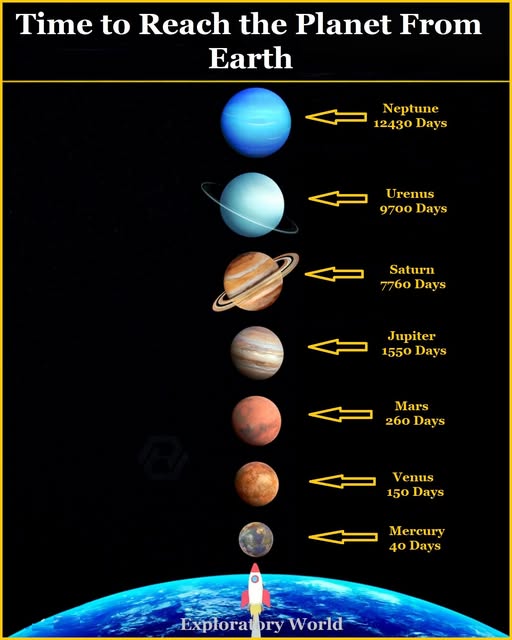
Neptune sits about 4.3 billion kilometers away. A straight shot on a super-fast spacecraft could still take 34 years to get there!
Uranus – A Chilling Voyage
Uranus, a frosty blue planet, lies around 2.9 billion kilometers from Earth. Estimated travel time? A cool 26.5 years.
Saturn – Rings That Take Time to Reach
Those beautiful rings come at a cost—21 years of travel time if you’re flying directly at top speed.
Jupiter – Our Giant Neighbor
Being the largest planet in our solar system doesn’t mean it’s the furthest. Jupiter is “only” about 4 years and 2 months away at full speed.
Mars – Humanity’s Next Home?
We dream of colonizing Mars, but it’s still an 8.5-month journey—on a good day with a direct route.
Venus – Closer But Tricky
Venus is the closest planet to us, but it’s still around 5 months away. Its thick atmosphere and intense heat make it a tough nut to crack.
Mercury – The Swift Planet
Tiny but mighty, Mercury is the fastest-orbiting planet around the Sun. A direct journey could take just 1.3 months—but missions usually take much longer.
Real Mission Timelines vs Theoretical Speeds
Voyager 2’s Journey to Neptune
Voyager 2, launched in 1977, used clever gravity assists to save fuel. It reached Neptune in 12 years, which is far better than a direct 34-year trip.
MESSENGER’s Long Trip to Mercury
Despite Mercury being close, NASA’s MESSENGER probe took 6 years to orbit it—proof that proximity doesn’t always equal speed.
Why Does It Take So Long?
Fuel Limitations
Carrying enough fuel to go fast and straight is impractical. Spacecraft need to be light and efficient.
The Need for Precise Orbits
Spacecraft need to line up with planets’ movements. Launch windows only come around every so often.
Avoiding Celestial Bodies
Space isn’t empty. Craft must avoid collisions and plan complex paths around gravitational fields.
The Role of Ingenuity and Engineering
Space travel is a puzzle. Engineers and scientists spend years designing missions to use planets’ gravity like a slingshot—saving time and fuel while staying on course.
The Vastness of Our Own Solar System
Even though we often think of our solar system as our cosmic backyard, it’s staggeringly vast. It can take over three decades just to reach the edge of it!
Why These Missions Matter
Science and Discovery
Each mission helps us understand the universe—its origin, evolution, and even the possibility of life elsewhere.
Future Human Missions
Planning future crewed trips to Mars and beyond starts with what we learn from these robotic journeys.
Global Cooperation
Space exploration brings countries together for a shared dream, inspiring generations.
Conclusion
Traveling through our solar system isn’t a quick road trip—it’s a massive undertaking full of challenges, calculations, and creativity. Every mission reminds us that space exploration takes time, but the rewards are infinite. Each journey brings us closer to understanding our place in this incredible universe.
FAQs
1. Why can’t we just fly straight to a planet?
Because space is dynamic—everything moves. Straight lines aren’t efficient or possible due to gravity and fuel limits.
2. What’s a gravity assist?
It’s like a slingshot maneuver using a planet’s gravity to speed up and redirect a spacecraft.
3. Why did it take MESSENGER so long to reach Mercury?
To slow down enough to enter Mercury’s orbit, MESSENGER had to take multiple flybys of Earth, Venus, and Mercury itself.
4. Can humans survive long journeys like to Neptune?
Not yet. We’d need life-support tech, radiation protection, and many more advances.
5. What’s the fastest spacecraft we’ve built?
Parker Solar Probe is currently the fastest, reaching speeds over 430,000 mph!
This article is AI generated. Please don’t forget to leave a review.